Labour Day RushOnlyplay · three reels by three rows · nine positions
Labour Day Rush symbols: eight tools, one gear, three double jobs
There are no card ranks on this reel set and no letters. Every symbol is an object you would find on a factory floor, drawn large enough that nine of them fill a screen without crowding, and three of them have a second job as the face of a jackpot level.
On a nine-cell board the symbol set is doing more work than usual. With so few positions, legibility at a glance is the difference between a game you can follow and one you cannot, and the set is designed around silhouettes that stay distinct when the board is the size of a phone.
Three tape measures, in three different rows and columns, each cell outlined on its own. The marking follows the objects rather than a drawn path between them.
The set at a glance
Workshop objects
8
recorded screens
Special symbols
1 Scatter gear
recorded screens, and the studio's announcement
Objects carrying a level
3
the jackpot panels on recorded screens
Wild
none recorded
no source states one
Safety gear anchors the theme
The welding mask is the most elaborate object on the set — a rounded blue shell with a bright
visor band across it — and it reads as premium before anything in a paytable confirms it,
simply because it has more drawn detail than anything beside it. The hard hat is simpler:
polished yellow, a single highlight, and a shape nobody could mistake for anything else at any
size.
The hat is also the Mini level, which means it appears twice on screen at once — once in a
reel cell and once in the panel at the bottom-left of the interface. Seeing the same object in
both places is the quickest explanation of the full-grid condition that this game offers,
better than a line of text.
Hand tools are chosen for their outlines
The wrench has a red handle and a steel head and sits diagonally in its cell. The hammer pairs
an orange handle with a silver head and sits diagonally the other way. The bolt is short,
dark and blunt, with a broad threaded body that points straight up.
Those three share a metallic palette, and on a busier board that would be a problem. Here it is
managed by shape alone: long diagonal one way, long diagonal the other, short vertical. Even in
a column of three the eye separates them without reading colour, which is exactly what a
nine-cell board needs when eight of its nine cells are in play for a jackpot condition.
The tape measure shows how matching is communicated
Bright green with a yellow strip pulling out of the case, the tape measure is the most
saturated object on the set and the one the recorded captures use most. One of them has three
of them lit — top-left, centre and bottom-right — with the amount drawn over the middle cell
and the other six cells left dark.
That capture is doing more work than its subject suggests. It demonstrates that illuminated
cells, not a drawn line, are how this game reports a result; it shows that a result can involve
cells scattered across the board; and it is the main reason the line count on
the attributes page is marked as a catalogue's figure rather
than as a fact.
Toolbox and control unit carry the upper levels
The red toolbox, open with a wrench and other tools showing above its rim, is the Major level.
The control unit — a yellow box with a red lever and a row of coloured buttons — is Grand. Both
turn up as ordinary symbols, both appear a second time in the panels on the left, and both are
marked there with x9.
Using reel symbols as the jackpot faces rather than inventing three badges is the detail that
makes the whole mechanic self-explanatory. A player who has seen three toolboxes pay an
ordinary win already understands what nine of them would be worth looking for.
The gear is the only symbol that changes the game's state
A bronze cog with SCATTER across it, lit from behind in
orange, is visibly larger and brighter than everything else on the set, and it is the only
object that does something other than pay. Three of them anywhere among the nine cells take the
game into its feature round.
The same cog shape is also the game's cover art and the motif around the award panel, so the
symbol reads as the title's emblem rather than as one more icon. On a set where every other
object is a tool, making the one special symbol the one machine part is a small piece of design
sense that costs nothing and explains itself.
Questions about the reel set
How many objects are on the reels?
Eight workshop objects plus the Scatter gear. Nothing on the set is a playing-card value or a letter.
Which objects carry a jackpot level?
The hard hat, the red toolbox and the control unit. All three keep working as ordinary symbols at the same time.
What does the Scatter look like?
A bronze cog with SCATTER across it in gold letters, surrounded by an orange glow that no other symbol has.
Is there a wild on this set?
Nothing recorded here shows one, and Onlyplay's description of the game names only the Scatter.
How is a winning object picked out?
Its cell gets a brighter outline inside the frame of bulbs it already has, and the amount is drawn across the middle of the board.
Do matching objects have to be adjacent?
One capture lights three tape measures in three separate rows and columns, so the marking is not tied to a straight run.
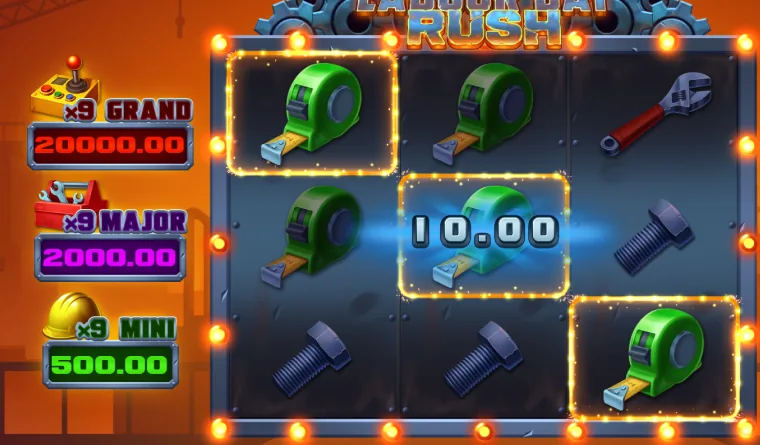 Three tape measures, in three different rows and columns, each cell outlined on its own. The marking follows the objects rather than a drawn path between them.