Labour Day RushOnlyplay · three reels by three rows · nine positions
Labour Day Rush gameplay: everything happens inside the same nine cells
The mechanic set here is short, and that is the point. A paid spin can produce an ordinary match, it can produce three Scatter gears, or it can produce nine identical symbols. There is no fourth thing, no side meter collecting towards something, and no state the board has to be resized to show.
Set against the current fashion for slots that reconfigure themselves every few spins, this reads as austere. It is also why the game is unusually easy to follow: a reader who understands the three outcomes above understands the whole game.
An ordinary match. Three hard hats along the bottom row take the bright inner outline; the amount sits over the middle cell, and the rest of the board carries on as normal.
What a spin is working with
Positions in play
9
the studio sheet, and every recorded screen
Board size during a feature
unchanged
recorded screens of the Scatter round
Return to player
95.16%
the studio sheet
Hit frequency
20.40%
the studio's announcement of the game
Paylines
five
a catalogue, and nobody else
Rules and gameplay: the three outcomes a spin can reach
Every spin drops nine symbols into nine fixed cells. If enough of one object is present in a
paying arrangement, those cells light and the amount is drawn across the middle of the board.
If three Scatter gears are present, the game leaves base play for its feature round. If all
nine cells hold the same object, the jackpot level attached to that object is awarded.
Those three outcomes are not variants of one another. The feature is triggered by a count of
one special symbol; the jackpot is triggered by a count of one ordinary symbol, and it has to
be all of them. A reader who has met slots where the bonus symbol also feeds a jackpot meter
should put that model aside here — the two conditions share a board and nothing else.
How a win is marked, and why it is not drawn as a line
Each of the nine cells is already framed by small bulbs. A winning cell gets a second outline
inside that frame, brighter and tighter, which is enough to pick it out against the dark steel
without any overlay crossing the board. Against a background this busy — orange light, pipes,
moving machinery — an outline reads faster than a coloured line would.
One recorded screen makes the consequence of that choice visible. Three tape measures are lit
in the top-left cell, the centre cell and the bottom-right one: three different rows, three
different columns. Whatever rule paid that combination, the interface communicates it by
illuminating the cells involved and nothing else. There is no path drawn between them.
This is also the reason the line count is absent from this site's own figures. Onlyplay states
none, the earlier version of this domain stated none, and the screens show marking that does
not depend on one. A catalogue puts the number at five, and that is where it appears
here — as a catalogue's figure, on the attributes page, with the attribution attached.
Bonuses and special features: the gear and the full grid
A bronze cog with SCATTER across it is the only special
symbol on the reels. It is drawn larger and brighter than the tools, with its own glow, and on
a nine-cell board three of them occupy a third of the screen — which makes the trigger
unmissable in a way it would not be on a board of thirty positions.
The confirmation is a colour change rather than an animation sequence: the factory behind the
reels goes from orange to purple with the gears outlined in gold,
and only then does the award panel appear. Splitting the trigger from the award this way means
the spin that caused it stays on screen long enough to be read.
The full-grid condition has no symbol of its own. Filling the whole three-by-three grid with matching symbols is all it asks, and the three objects that can do it are marked permanently in the panels
on the left so there is never a question of which ones count.
Controls sit outside the playing area
The right-hand column holds the spin control, with autoplay and a fast-play toggle beneath it
and the sound and menu buttons above. They are circles against a board of squares, they sit
entirely outside the nine cells, and nothing in the control stack ever overlaps a symbol —
which matters more on this game than on most, because the one thing a player needs to see is
how many cells currently hold the same object.
During the feature round that same spin control doubles as a counter, showing how many free
spins are left rather than the usual arrows. It is worth knowing, because a number inside that
circle has nothing to do with the x9 marks on the jackpot panels, and the resemblance
has misled readers before — including an earlier version of this site, which took a nine in the
spin control for a nine-symbol progress indicator. It was a spin count.
Questions about how it plays
How many positions does a spin fill?
Nine. Three columns of three, and the count never changes — not during the Scatter round and not while a jackpot pattern is building.
How is a winning symbol shown?
The cell gets a second, brighter outline inside the frame it already has, and the amount appears across the middle of the board.
Do wins have to sit in one row?
No. One recorded screen shows three tape measures lit in three different rows and columns, so the marking follows individual cells rather than a drawn line.
Does the board ever grow?
Not in anything recorded here, and Onlyplay's description of the game does not mention it either. The nine cells are the whole playing area.
How many lines does the game pay on?
Onlyplay does not say. A catalogue states five; that is the catalogue's figure and not one this site can confirm.
Is there a buy-in for the feature?
Nothing recorded here shows one, and the studio's account of the game does not mention one.
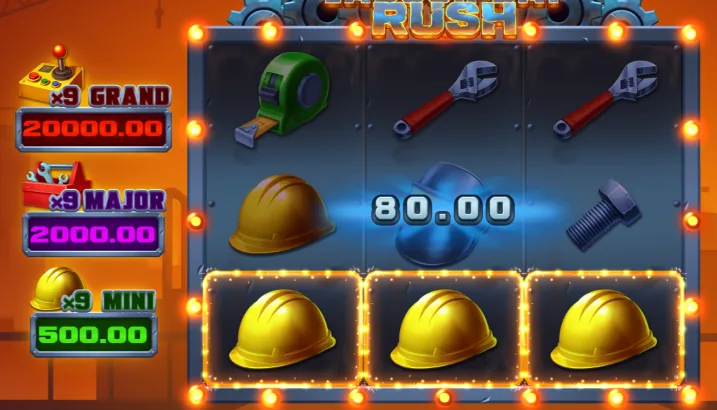 An ordinary match. Three hard hats along the bottom row take the bright inner outline; the amount sits over the middle cell, and the rest of the board carries on as normal.