Labour Day RushOnlyplay · three reels by three rows · nine positions
Labour Day Rush jackpots: three fixed levels and one nine-symbol condition
Three panels sit down the left edge of this game on every spin it ever makes. Grand at the top, Major in the middle, Mini at the bottom, each one showing an object, a figure, and a small mark reading x9. They are the reason the board is only nine cells wide.
Getting them right takes a little care, because two things about these panels are routinely misread elsewhere — the x9 is taken for a multiplier, and the game's stated ceiling is taken for the size of the top level. Neither is what the screen says.
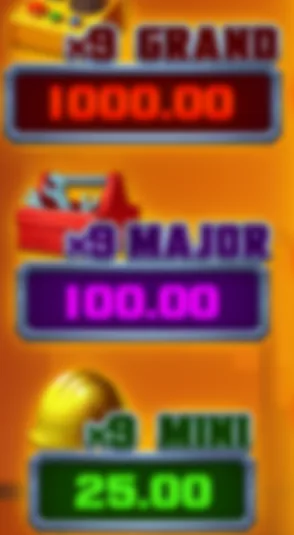
The three panels as they appear beside the reels. Each carries the object that wins it, the mark x9, and the figure that level is currently worth.
What the panels state
Levels
3
recorded screens, and the studio's announcement
Condition
9 identical symbols
the studio's announcement
Mini
a yellow hard hat
recorded screens
Major
a red toolbox
recorded screens
Grand
an industrial control unit with a red lever
recorded screens
Level type
fixed
a catalogue, and consistent with the screens
The condition is the whole board, and nothing less
Onlyplay's own account of the game puts it in one clause: the levels are reached by
filling the whole three-by-three grid with matching symbols. Not a cluster, not a row, not a count collected over several spins — every
one of the nine cells, in a single spin, holding the same object.
That is why the marks on the panels read x9. Nine is the number of copies the
condition asks for, which on this board happens to be every position there is. On a slot with
twenty positions the same mark would be a partial condition; here it is a full house, and the
two facts are the same fact.
It is also why reading x9 as "nine times the stake" goes so badly wrong. The
network this site belongs to has made that class of error before, on a different game, where a
label on a bonus ladder was taken for the game's maximum win. Here the mark is a count of
symbols and the panels print the money separately, directly underneath.
Mini, Major and Grand are three ordinary symbols doing a second job
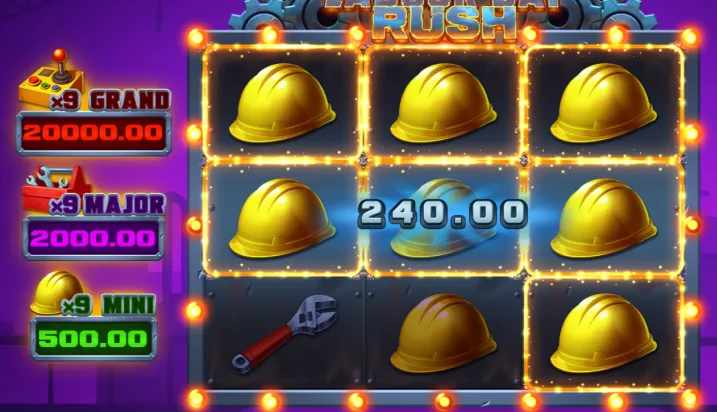
Nothing on this reel set exists only to be a jackpot icon. A yellow hard hat is the Mini level and also a symbol that turns up in ordinary spins — one recorded screen
has three of them lit along the bottom row for a normal win. A red toolbox is Major and also a regular symbol. An industrial control unit with a red lever is Grand and also a regular symbol.
So the difference between an ordinary hard-hat win and the Mini level is arithmetic, not
identity: three hard hats is a win, nine hard hats is Mini. The panels keep the three
candidates permanently in view precisely so a player never has to ask which objects are in play
for the big condition.
One symbol short. Eight cells hold hard hats and the ninth holds a wrench — an ordinary win is paid, the Mini condition is not met, and on a board this size the single cell that spoiled it is impossible to miss.
That frame is the clearest argument for the small board there is. A near miss on a wide reel set
is a shrug; here the one object out of place is sitting in the bottom-left corner in plain sight.
The game does not need a progress meter because the progress is the board.
Fixed levels, not a pot that grows
The figures in the panels change with the stake and with nothing else. Two captures kept with
this site make that checkable. On one, taken at a twenty-unit stake, the three panels read 500,
2,000 and 20,000. On the other, at a stake twenty times smaller, the same three panels read 25,
100 and 1,000 — the identical proportions, scaled down by exactly the factor the stake changed
by.
A progressive jackpot does not behave like that. It accumulates from play across an operator or
a network, it is quoted as a running amount rather than as a function of what you happen to be
staking, and it does not drop by a factor of twenty because you lowered your bet. What these
panels show is a fixed level expressed as a multiple of the stake, which is also the word a
catalogue uses for them.
The one number this page will not give you
What that multiple actually is, this site does not state, and the reason is a straight
disagreement between two sources that both describe this game.
The capture that showed the stake and the panels together works out to 25, 100 and 1,000 times
the stake for Mini, Major and Grand. A catalogue that lists this title prints
12.5, 50 and 500 times the stake — exactly half, across all three levels at once, which is the shape
of a disagreement about what counts as the stake rather than three separate errors. Onlyplay's
own sheet settles nothing: it gives the return, the volatility and the ceiling, and says nothing
about the levels at all.
The stated ceiling does not break the tie either. 2,530x the stake is comfortably above
both candidates for Grand, so either could be true without contradicting it. One reading against
one reading, with the publisher silent, is not a confirmed figure — so the figures above are
given as what each source says, and neither is printed as the size of the jackpot.
Where 2,530x belongs, and where it does not
2,530x is on Onlyplay's sheet as the maximum
win for the game. It covers everything the product can do — ordinary matches, the Scatter round,
and a filled grid — and it is a ceiling rather than a feature size. The earlier version of this
site called it "maximum exposure", which is the same quantity under a more cautious name.
A page that presents it as the Grand level is making the same mistake as a page that reads
x9 as a multiplier, just in the other direction: it attaches the whole game's
outer limit to one of its three components. If you find this game described with a ceiling well
above 2,530x, that is usually a different Onlyplay slot whose name begins with the same two
words, and the attributes page sets out how to tell them apart.
Questions about the three levels
How is a jackpot level taken?
All nine cells have to hold the same object. Which level pays is decided by which object it was.
What do the x9 marks beside the panels mean?
Nine copies required. They are a count of symbols, not a multiplier — a nine-of-a-kind condition on a nine-cell board.
Which symbol carries which level?
The hard hat carries Mini, the red toolbox carries Major, and the industrial control unit carries Grand. All three are ordinary reel symbols as well.
Are these progressive jackpots?
No. The panels show fixed levels that move with the stake and not with how long the game has gone unwon — two captures at different stakes show the same proportions.
How large is each level?
Onlyplay does not publish the multiple. A reading taken from a capture that showed the stake alongside the panels gives one set of figures; a catalogue prints half those. Neither is treated here as the answer.
Is 2,530x the size of the Grand level?
No. That is the ceiling Onlyplay states for the whole game, across ordinary wins, the Scatter round and the levels together.
Can a jackpot land during free spins?
The panels stay on screen throughout the round and the condition is unchanged, so nothing recorded here suggests otherwise.
 The three panels as they appear beside the reels. Each carries the object that wins it, the mark x9, and the figure that level is currently worth.
  One symbol short. Eight cells hold hard hats and the ninth holds a wrench — an ordinary win is paid, the Mini condition is not met, and on a board this size the single cell that spoiled it is impossible to miss.