Labour Day RushOnlyplay · three reels by three rows · nine positions
Labour Day Rush free spins: three gears, a colour change, ten spins
The feature round of this game is a single, clean sequence. Three Scatter gears appear somewhere among the nine cells, the factory behind the reels turns from orange to purple, a riveted metal panel confirms ten free spins, and play resumes on exactly the board it left.
There is no wheel to pick a variant, no choice of volatility, and no second screen. Everything the round does, it does on the frame already in front of you — which is the design decision the whole game is built around.
The trigger as it looks on screen. Three gears, the background already switched to purple, and the other six cells still holding ordinary tools.
What the round is and is not
Scatters needed
3
the studio's announcement, and recorded screens
Spins awarded
10
the award panel on a recorded screen
Board during the round
the same 9 cells
recorded screens of the round
Return applying to the round
95.16%
the studio sheet, for the whole game
The trigger does not need a row
A Scatter is defined by not caring where it lands, and this game holds to that. The recorded
trigger kept with this site has its three gears in the top-right cell, the bottom-left one and
the bottom-centre one — no row, no column, no diagonal. The remaining six cells carry on
showing hammers, toolboxes and tape measures as though nothing had happened.
On a nine-cell board that is more striking than it sounds. Three of nine positions is a third
of the playing area taken up by a symbol drawn twice as bright as everything around it, so the
trigger announces itself before any colour has changed. There is no scanning for a small icon
at the edge of a wide board.
Colour is the confirmation
The factory scene behind the reels is the game's status light. In base play it is lit orange,
the colour of the furnace; the moment the trigger is complete it goes purple, and the three
gears pick up a gold outline they did not have a moment earlier. The reel plate, the bulbs and
the jackpot panels stay exactly where they were.
Using the background rather than an overlay has a practical payoff. Nothing covers the nine
cells at the moment a player most wants to see them, and the change survives being viewed on a
phone at arm's length, which a small badge in a corner would not.
The award panel says ten in words
The next state clears the reels entirely. A metal panel with pipe-work down each side sits in
the middle of a field of glowing gears, and it reads, in three lines, that ten free spins have
been won. The number is given as a number and labelled as spins.
The award panel. The count is stated in words on its own line, so it cannot be read as a win amount or as a jackpot figure.
That separation is worth pointing out, because on a lot of slots the spin count arrives as a
number flashing over the reels at the same moment a win amount is also being drawn there. Here
the reels are gone and the only number on screen is the one being awarded. It is a small
courtesy and this game is built out of them.
What the round changes, and what it leaves alone
The board does not grow, the symbol set does not change, and the jackpot panels do not go
anywhere — a full grid of one object pays its level during the feature exactly as it would in
base play. The round spin control switches from its usual arrows to a count of the spins
remaining, which is the one piece of interface that behaves differently.
That counter has caused confusion, and it is worth naming. A nine showing inside the spin
control during the round means nine free spins are left out of ten. It is not a progress
reading on the nine-symbol jackpot condition, despite the x9 marks on the panels a
few centimetres to its left. An earlier version of this site made exactly that mistake, and
the screen it was reading is the one on the jackpots page.
Beyond the counter, Onlyplay publishes nothing that separates the feature from the base game
mathematically — no feature-only return, no stated frequency for entering it. The 95.16% on the studio's sheet is the figure for the whole product, and a page that splits it into
a base figure and a feature figure has invented the split.
Questions about the Scatter round
How many Scatters open the round?
Three. They can sit anywhere among the nine cells; one recorded trigger has them top-right, bottom-left and bottom-centre.
How many spins does the Labour Day Rush trigger panel announce?
Ten. The panel that appears after the trigger says so in plain words rather than leaving it to a counter.
What does the Scatter look like?
A bronze cog with SCATTER written across it in gold, lit with an orange glow that separates it from the tools around it.
Does the round use a bigger board?
No. The same nine cells carry the feature, which is why entering it costs nothing in layout on a phone.
Do the Labour Day Rush free spins retrigger?
Nothing recorded here shows a retrigger, and neither Onlyplay's sheet nor its announcement of the game mentions one.
Does the free round have its own return figure?
None is published. The 95.16% Onlyplay states covers the whole game, this round included.
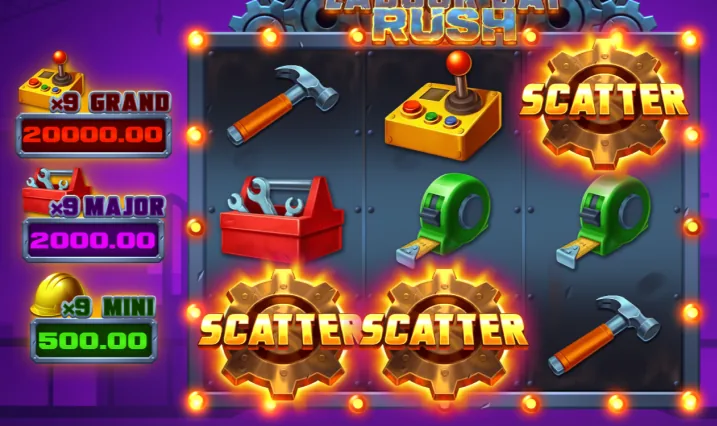 The trigger as it looks on screen. Three gears, the background already switched to purple, and the other six cells still holding ordinary tools.
 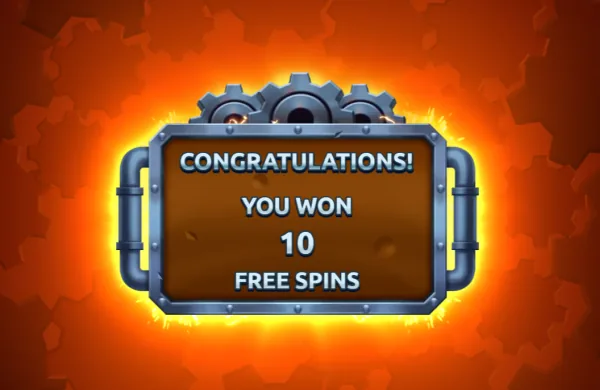 The award panel. The count is stated in words on its own line, so it cannot be read as a win amount or as a jackpot figure.